How I Grew an E-commerce Website from 0 to 11K Traffic in 6 Months
When Bump 2 Cradle came to me in October 2024, the website had zero organic traffic. Not low traffic. Zero. No rankings, no indexed content worth mentioning, no backlink profile. The domain was essentially invisible to Google.
- Project Duration : Oct 2024 – Feb 2025

| Month | Organic Traffic / Source GA | Click / Source GSC | Impressions / Source GSC |
|---|---|---|---|
| Sep 2024 | 0 | 0 | 0 |
| Oct 2024 to Feb 2025 | 11056 | 10557 | 115858 |
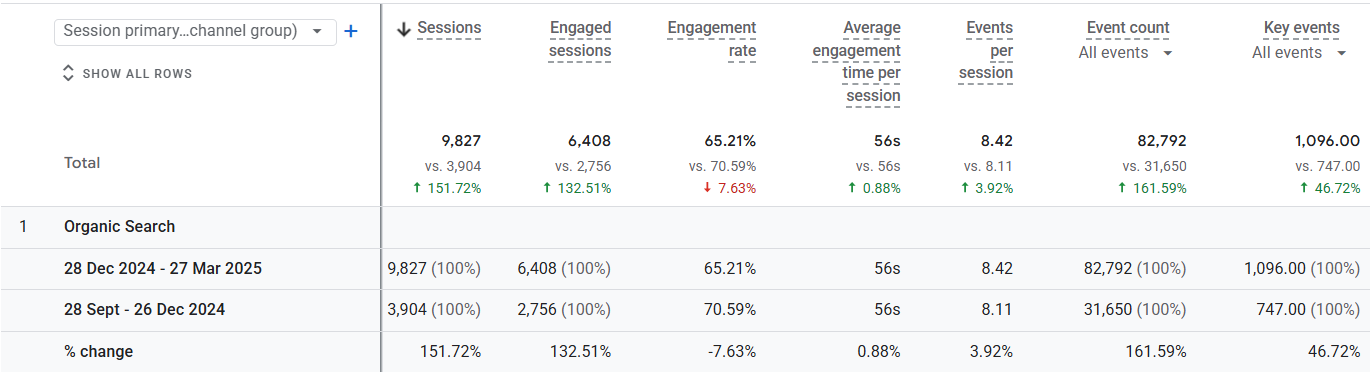
Six months later, the site had 11,056 organic visits, 10,557 clicks, and 115,858 impressions from Google Search Console. Organic sessions grew 151.72% in the last 90 days compared to the previous 90 days.
This ecommerce SEO case study breaks down exactly what was done, in what order, and why it worked.
About the Client
Bump 2 Cradle is an Indian ecommerce brand selling maternity and baby products. The product range covers everything from feeding essentials to newborn care kits and pregnancy must-haves. The target customer is a first-time parent or an expecting mother, someone who searches with very specific product needs and a strong intent to buy once trust is established.
The website was new. The brand had no organic footprint. Everything had to be built from scratch.
The Goal
The goal coming into this project was to build real organic visibility for a brand-new domain, without touching paid ads, and to get consistent inbound traffic moving within six months. Every metric that came out of this had to be real, tracked through GA4 and GSC, not inflated numbers dressed up to look good in a report.
The measure of success was real organic sessions from Google, tracked through both Google Analytics and Google Search Console.
The Challenges
Starting from zero on a new ecommerce domain in a competitive parenting niche is genuinely difficult. Three specific problems shaped the entire approach.
Second, the baby and maternity category in India is crowded. Established players like FirstCry, Mothercare, and dozens of D2C brands have years of content, thousands of backlinks, and category dominance on high-volume terms. Going head-to-head on those terms from a new domain would have produced nothing.
Third, ecommerce SEO for a new website is a sequencing problem. Get the technical foundation wrong early, and every piece of content you publish underperforms. The order of operations matters more than most people realise.
Strategy and Execution
a) Keyword Strategy
The entire keyword approach was built around one principle: avoid competition you cannot win yet.
High-volume, short-tail keywords like “baby products online” or “maternity wear India” were off the table in the early months. Those SERPs are locked up by brands with domain ratings above 60. Targeting them on a new domain is a waste of content budget.
Instead, the focus went on long-tail transactional keywords with clear buying intent and low keyword difficulty. These are searches where someone already knows what they want. Terms like “organic cotton swaddle set for newborns” or “postpartum belly wrap India” have lower monthly search volume individually, but they convert at a much higher rate, and a new domain can actually rank for them.
The split was roughly 80% transactional and commercial investigation keywords targeting product and collection pages, and 20% informational keywords targeting blog content that would bring in new parents earlier in their research phase and route them toward products through internal links.
Keyword research pulled from SEMrush for volume and difficulty data, Google Suggest for real search behaviour, and the People Also Ask section for secondary question clusters around each topic.
| Keyword Type | % of Total Effort | Target Page Type |
|---|---|---|
| Transactional (product intent) | 60% | Product and collection pages |
| Commercial investigation | 20% | Comparison and category pages |
| Informational (awareness) | 20% | Blog posts |
b) Content Strategy
Two content tracks ran simultaneously from the start.
Collection pages got SEO-optimised copy first. Most ecommerce brands leave these pages with no text at all, or a single generic paragraph. That is a missed ranking opportunity. Each collection page at Bump 2 Cradle got a properly structured content block: a keyword-aligned opening paragraph, a benefits section, an FAQ pulling from People Also Ask data, and internal links to related products and categories.
Blog content targeted the informational queries that expecting and new parents search for at every stage: what to pack in a hospital bag, newborn feeding schedules, how to choose a baby carrier, safe sleep guidance. Each article was written to answer the query completely and then point toward relevant products with contextual CTAs, not banners or pop-ups, but in-line text links that felt like natural recommendations.
The content calendar was prioritised by potential traffic value and internal linking benefit, not just search volume alone.
c) On-Page SEO
Every page that went live or was updated got a complete on-page pass before publication.
Title tags were written with the primary keyword close to the front and kept within 60 characters. Meta descriptions were written for click-through rate, not just keyword inclusion. H1 and H2 structure followed search intent, not just aesthetics. Product images got descriptive alt text covering the product name, material, and relevant attribute. FAQ schema was added to blog posts and collection pages where applicable to increase SERP real estate.
Internal linking was treated as a deliberate architecture decision. Every blog post linked to at least two product or collection pages. Every collection page linked to related categories and relevant blog content. This kept crawl depth shallow and distributed page authority across the site rather than letting it pool on the homepage.
d) Technical SEO
Before any content went live, the technical foundation was audited and fixed.
The XML sitemap went into Google Search Console on day one. Canonical tags were placed on filtered URLs, the kind that multiply fast on ecommerce sites when someone sorts by price or color. Robots.txt got a full read-through to make sure no important pages were sitting behind a crawl block by mistake.
Core Web Vitals were brought into acceptable ranges, with particular attention to Largest Contentful Paint on mobile. Given that the majority of Indian ecommerce traffic arrives on mobile devices, page speed on mobile was treated as a conversion factor as much as an SEO factor.
Structured data was added to product pages covering product name, price, availability, and review schema to support rich result eligibility in Google Search.
e) Link Building
Even a handful of quality backlinks makes a material difference for a new domain. Outreach targeted parenting blogs, baby product review sites, and a few mommy blogger collaborations. The goal was not volume but relevance. Three or four backlinks from topically relevant sites carry more weight for a baby products domain than twenty links from unrelated directories.
A few guest posts in parenting and lifestyle publications helped accelerate the domain’s authority enough to push collection page rankings into the top 20 for target keywords, after which on-page quality took over.
Key Growth Driver
The single tactic that drove the most early traction was writing proper SEO copy on collection pages before almost any blog content went live.
Most ecommerce sites in the baby product space have bare collection pages. Search for “newborn essentials online India” and look at what competitors actually have on those pages. Usually nothing. A page title, a product grid, and a footer. That gap is an opportunity.
By putting well-structured, keyword-relevant content on collection pages from the start, the site started picking up long-tail rankings within the first 8 to 10 weeks. Those rankings brought in the first real traffic, which built the early engagement signals that helped other pages rank faster.
Results I have achieved
| Metric | Sep 2024 | Oct 2024 – Feb 2025 |
|---|---|---|
| Organic Traffic (GA) | 0 | 11,056 |
| Clicks (GSC) | 0 | 10,557 |
| Impressions (GSC) | 0 | 115,858 |
| Average CTR | – | 9.1% |
| Average Position | – | 10.8 |
Organic sessions grew 151.72% in the 90-day period ending March 2025 compared to the previous 90 days. Engaged sessions went from 2,756 to 6,382, a 131.57% increase. Key events tracked in GA4 grew 45.65% over the same comparison window.
Reach out at contact@shantanarang.com, visit shantanarang.com, or connect on LinkedIn. The first step is a conversation about where your site stands and what is worth fixing first.
 WhatsApp