Every time you search for something on Google, results appear in less than a second. But how do search engines work behind that speed? The answer involves three stages, crawling, indexing, and ranking, and none of them happens in real time. Search engines don’t scan the live web when you type a query. They pull results from a pre-built database assembled days or weeks before your search. How search engines work, how search engines work, and why some pages show up on page one while others never appear at all comes down to how well a site performs across each of these three stages.
Comprehensive Summary
- How do search engines work: A search query doesn't trigger a live web scan; Google matches it against pages already stored in its index through prior crawling and indexing
- Search engine crawling: Googlebot discovers pages by following internal links and reading XML sitemaps; a page sitting with no links to it can go undetected for months, regardless of content quality
- Search engine indexing: After crawling, Google reads the page and filters it against quality and duplication checks before deciding whether it belongs in the index; a crawled page is not automatically an indexed one
- Search engine ranking: The search engine algorithm scores every indexed page competing for the same query using signals like relevance, backlinks, search intent match, and Core Web Vitals, then assigns positions on the SERP
- How Google indexes websites: When multiple URLs carry near-identical content, Google picks one canonical page to store and ignores the rest; without a canonical tag, that choice may not be the URL you wanted
- Search engine results page (SERP): Every result on the SERP earned its position through all three stages; a page missing from the SERP has a problem at crawling, indexing, or ranking, and each points to a different fix
Key Takeaways
- Search engine crawling is the stage where Googlebot moves across the web following links; pages with no internal links pointing to them simply don't get found
- Search engine indexing is Google's evaluation step, where crawled pages either earn a spot in the database or get filtered out for duplication, thin content, or a noindex tag
- Search engine ranking uses the search engine algorithm to sort indexed pages on the search engine results page by how well each one matches the query, not just the keyword
Not sure if Googlebot can even find your site?
Uncover hidden crawl errors and indexability issues on your site
Fill the form to get in touch.
What is a search engine?
So, what is SEO? A search engine takes a user’s query and returns the most relevant pages from its stored database. Google leads the pack, followed by Bing, DuckDuckGo, and Yahoo, though each runs on different technology and weighs ranking signals differently. StatCounter data says that Google has over 91% of the global search market share, which is why most SEO for beginners resources default to Google when explaining how the whole system works.
The job of a search engine goes beyond simple retrieval. Two people typing the same phrase can get different results depending on their location, device, and how each engine reads intent. Before any of that matters, a page has to survive crawling and indexing first.
The purpose of a search engine isn’t just retrieval; it’s relevance. Two people searching the same phrase can get slightly different results depending on location, search history, and how each engine interprets intent. Before any of that matters, though, a page has to make it through crawling and indexing first.
How do search engines work? (Overview)
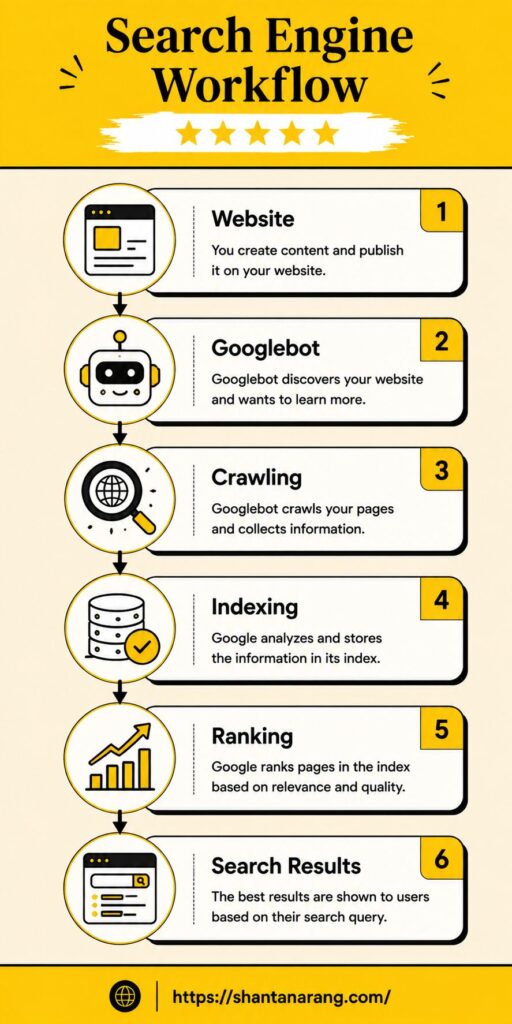
The three-stage process runs in sequence and cannot be reordered. Crawling comes first, indexing second, ranking third.
- Crawling: Googlebot discovers pages by following links and reading sitemaps
- Indexing: Google evaluates those pages and stores qualifying ones in its database
- Ranking: the search engine algorithm assigns positions on the SERP for each query
Miss the first stage and none of the rest applies. A page blocked from crawling stays invisible. A page crawled but excluded from the index never ranks. Understanding where a page learn seo in this pipeline is the first diagnostic step in any SEO Roadmap for Beginners.
Ready to put this into practice?
See how these three stages translate into an actual step-by-step SEO plan.
Fill the form to get in touch.
Step 1: Search engine crawling
Search engine crawling is discovery. Googlebot, an automated program Google runs continuously, moves across the web by following links from page to page, adding URLs to its queue as it goes.
What Googlebot does during a crawl:
- Works through a queue of known URLs from previous crawls and newly submitted sitemaps
- Follows internal links to find other pages sitting within the same domain
- Reads XML sitemaps submitted through Google Search Console
- Checks each site's robots.txt file before reading any content, since that file controls which pages crawlers are allowed to access
Two things trip up beginners here. The first is internal linking. A page that no other page links to has no path for Googlebot to follow. The content can be excellent; without a link pointing to it, the page may stay undiscovered for months. The second is robots.txt. One accidental entry in that file can block Googlebot from entire sections of a site, and there’s no error message to alert you.
Sites that publish regularly and maintain clean internal link structures get crawled more frequently than sites that go weeks without any changes.
Step 2: Search engine indexing
Once Googlebot visits a page and reads its content, that data goes back to Google’s servers. Search engine indexing is what happens next: Google processes the page and decides whether it belongs in the index.
Pages get excluded from the index for several reasons:
- A noindex tag on the page tells Google not to store it
- The content matches another URL Google has already indexed
- The page has too little original information to justify storing
- A canonical tag points to a different URL as the preferred version
How Google indexes websites depends heavily on how clearly a site communicates its structure. When two or three URLs display nearly the same content, Google picks one to index and skips the rest. If no canonical tag exists to guide that decision, Google makes its own call, and that may not be the URL that was intended to rank.
The noindex tag catches a lot of people off guard. Several WordPress themes and plugins apply it to certain page types by default. Pages marked noindex won’t appear in search results no matter what else is done to them.
Step 3: Search engine ranking
After a page enters the index, it enters the ranking process. Search engine ranking is how Google orders every indexed page competing for the same query.
The search engine algorithm pulls from a long list of signals. The publicly confirmed ones include:
- Relevance: how directly the page addresses what was searched
- Content quality: whether the information is accurate and written to genuinely inform rather than to manipulate rankings
- Search intent: whether the format of the page matches what searchers actually want from that query
- Backlinks: the number and quality of external sites linking to the page
- User experience: page speed, mobile usability, and Core Web Vitals scores
- Freshness: for queries where recency matters, how recently the page was updated or published
Google has stated publicly that its ranking systems rely on hundreds of signals. The full list stays private. Relevance and content quality sit at the base of how search engine works regardless of which algorithm update runs.
Want to learn more about SEO?
Download our free eBook covering crawling, indexing and ranking in more depth.
How Google decides which page ranks first
What actually drives ranking decisions:
- Search intent match: a page targeting "how do search engines work" has to be read as an educational guide. A product-focused page targeting the same keyword loses rank because the format contradicts what searchers expect, regardless of its backlink count
- Helpful Content: Google's Helpful Content system pulls ranking weight away from pages built around ranking tactics and gives it to pages that genuinely answer the question. This system now evaluates the entire site, not individual pages in isolation
- E-E-A-T: Google's Search Quality Rater Guidelines reference Experience, Expertise, Authoritativeness, and Trustworthiness. Pages with named authors and verifiable credentials on a subject consistently outrank anonymous content on the same topic. For anyone building content through an SEO Career Guide or learning resource, author credibility carries more weight now than it did a few years back
- Page experience: Core Web Vitals scores, HTTPS, and mobile usability all feed into where a page lands on the SERP
What happens after you publish a website?
Publishing a page starts a process that has multiple steps, each with its own timeline. The gap between hitting publish and appearing in search results surprises most beginners.
The sequence:
- Page goes live on the site
- Googlebot discovers it through an internal link, an external link from another site, or a submitted XML sitemap
- Googlebot crawls the page and sends the data back to Google
- Google evaluates the page and decides whether to add it to the index
- The indexed page enters the ranking evaluation queue
- The search engine algorithm scores it against competing pages
- The page appears on the search engine results page for relevant queries
For a brand-new site with no authority and no backlinks pointing to it, this process can stretch to several weeks. Sites with established crawl schedules and a pattern of regular updates move through the middle steps faster.
Common reasons Google doesn't index pages
Getting crawled doesn’t guarantee getting indexed. A page can show up in Googlebot’s logs and still be absent from search results because of:
- Blocked by robots.txt: Googlebot reads the URL but the page content is off-limits, so nothing gets processed or stored
- Noindex tag: the page carries a directive instructing Google to skip it, sometimes placed there by a plugin without the site owner realising
- Weak internal linking: pages with one or zero internal links pointing to them get crawled infrequently and get dropped from consideration more easily
- Duplicate content: Google identifies the page as a copy of another indexed URL and stores only the canonical version
- Thin content: pages that cover a topic with minimal depth get passed over in favour of pages that treat the subject more completely
- Orphan pages: pages that live on the site but have no other page linking to them
Google Search Console’s Page Indexing report shows which pages have been crawled but excluded, along with the specific reason for each one.
How to help Google crawl and index your website faster
Faster crawling and indexing comes from removing the obstacles Google encounters. These aren’t tactics for advanced users; they apply to every site at every stage.
- Submit an XML sitemap through Google Search Console so Googlebot gets a direct, current list of URLs rather than discovering them by accident
- Add internal links from existing pages to new content so there's always a path for Googlebot to follow
- Audit and fix broken links regularly; dead links burn through crawl budget without delivering any value
- Improve page load speed so Googlebot can process more pages in a single crawl session
- Write pages that cover the topic with enough depth that Google considers them worth storing
- Use the URL Inspection tool in Google Search Console to manually request indexing for new or recently updated pages
These steps show up in every credible SEO Career Guide because they hold across algorithm changes. The underlying mechanics of crawling and indexing don’t shift the way ranking signals sometimes do.
Search engine crawling vs indexing vs ranking
Treating these three terms as interchangeable leads to fixing the wrong thing when a page isn’t appearing in search. Each stage has a distinct function and a distinct set of problems.Multiple social bookmarking websites enable users to vote, comment, and perform other actions. This allows companies to establish a rapport with their users and executives online.
Stage | What happens | Who performs it | Output |
|---|---|---|---|
Crawling | Pages are discovered and visited | Googlebot | Content read and added to processing queue |
Indexing | Pages are evaluated and stored | Google’s indexing system | Page eligible to appear in search |
Ranking | Pages are ordered for each query | Search engine algorithm | Position assigned on the SERP |
A page stuck at crawling needs a technical fix, usually around robots.txt, internal links, or sitemap submission. A page crawled but missing from the index has a content or directive problem, such as a noindex tag or duplicate content. A page in the index but ranking on page five has a relevance or authority gap that no technical fix alone will close.
How Google search works vs other search engines
How Google search works differs from competing engines mainly in the depth of its index and the sophistication of its ranking signals.
|
Search engine |
What sets it apart |
|---|---|
|
|
Largest index globally; uses E-E-A-T, Core Web Vitals, and hundreds of confirmed ranking signals |
|
Bing |
Powers Yahoo results; places more weight on social signals and gives older domains a slight edge |
|
DuckDuckGo |
Pulls results from Bing and its own crawler; no user tracking, no personalised results |
|
Yahoo |
Results have been powered by Bing since 2009; runs no significant independent index |
How the Google search engine works gets more attention than any other engine because Google search accounts for the largest share of organic traffic across every category. Most SEO Terminology Guide resources focus on Google by default, and ranking on Google is the target for most site owners.
Common myths about search engines
Misinformation about how do search engines work spreads quickly in beginner communities. A few beliefs in particular tend to push people toward decisions that accomplish nothing
Myth 1: Google indexes pages right after they go live.
The timing depends on how often the site is crawled, how well it is internally linked, and whether a sitemap has been submitted. Even sites that Google crawls regularly can take a few days for a new page to appear in the index.
Myth 2: Using a keyword more often makes the page rank higher for it.
Frequency above what reads naturally signals low quality. It doesn’t lift rankings; it often lowers them. This ranks among the most repeated SEO Myths that get passed around without scrutiny.
Myth 3: If Googlebot crawled a page, it will rank.
Crawling is the first stage, not the last. A crawled page still has to pass indexing review and then compete against every other indexed page for the same query.
Myth 4: Being in the index means ranking well.
The index holds billions of pages. Getting in means the page is eligible to appear in results. Where it actually appears depends on how its signals stack up against every competing page for that query.
Conclusion
How search engines work follows the same sequence every time. Googlebot finds pages, Google evaluates and stores the qualifying ones, and the search engine algorithm ranks those stored pages against each other for each query. The search engine results page reflects that ranking output.
For anyone starting with SEO for beginners material, this process is the foundation. A page that isn’t crawled cannot be indexed. A page that isn’t indexed cannot rank. Knowing which stage is failing narrows down the fix immediately, and that’s worth more than any individual tactic found in any SEO Roadmap for Beginners.
FAQ’s on How Do Search Engines Work
How do search engines work?
How does a search engine work?
How do search engines work for a new website?
What is search engine crawling?
Crawling is when Googlebot visits a URL, reads the page content, and follows links to discover more pages on the site
What is search engine indexing?
Indexing is Google storing a crawled page in its database after confirming it meets quality, originality, and accessibility standards
What is search engine ranking?
Ranking is the search engine algorithm ordering indexed pages by position on the SERP based on relevance, backlinks, and user experience signals
How long does Google take to index a page?
A few days for established sites with strong internal linking; several weeks for newer or low-authority sites
Can Google rank a page that isn't indexed?
What is Googlebot?
Crawling is discovery, Googlebot visits and reads the page; indexing is storage, Google decides whether to keep it in its database
What is the difference between crawling and indexing?
What is a search engine results page (SERP)?
The SERP is the page Google displays after a search, listing ranked results pulled from its index in order of relevance
What is a search engine algorithm?
A set of rules and signals Google uses to score and rank indexed pages for every query, covering hundreds of factors, including content quality and backlinks