Type “SEO course” into Google and the first page is owned by Coursera, HubSpot, Udemy, and Google itself. A new site has no realistic path onto that page this year, probably not next year either.
Type best SEO course for beginners in India under 5000 rupees and the picture changes completely. Long tail keywords like that one carry real search volume, lower competition, and visitors who are already close to a decision. Most of the web’s actual search traffic flows through these specific, longer phrases, not the short broad terms that dominate every beginner keyword list.
According to data published by Ahrefs on search behaviour, the majority of search queries are made up of four or more words. Broad one and two-word terms account for a much smaller share of total search volume than most people assume when they start doing keyword research.
This guide covers what long tail keywords are, why they produce better results for most sites, real India-focused examples, and where to find them before your competitors do.
Key Takeaways
Comprehensive Summary
What Are Long Tail Keywords?
Long tail keywords are specific, multi-word search phrases that target a narrower audience than broad terms. They typically have lower search volume, lower keyword difficulty, and higher conversion potential because the person searching already knows what they want.
The phrase comes from the long tail of a search demand curve. Broad terms like “SEO” or “shoes” sit at the head of the curve with massive volume. Long tail terms make up the extended tail, individually smaller in volume but collectively accounting for the large majority of all searches performed.
A long tail keyword is not defined purely by word count. “Digital marketing” is two words and very broad. “Digital marketing course for small business owners in Pune” is long tail, not because it is longer, but because it is specific, lower competition, and signals clear intent.
Why Long Tail Keywords Matter for SEO
Broad keywords are dominated by sites with years of authority behind them. Long tail keywords are where newer and smaller sites actually get traffic.
Easier to rank for
Broad head terms are contested by high-authority domains with thousands of backlinks. Long tail terms attract less competition because fewer sites specifically target them. A page on a newer site targeting “affordable SEO services for restaurants in Jaipur” has a far more realistic path to page one than a page targeting “SEO services.”
Keyword difficulty scores reflect this directly. A primary keyword like “SEO” can have a KD above 90. A specific long tail version of the same topic often sits under 20.
Attracts more qualified traffic
Someone searching what is SEO is early in their learning journey. Someone searching “how to hire an SEO expert for my ecommerce store in India” is much closer to taking action. Long tail seo traffic converts better because the specificity of the query filters out casual browsers before they even click.
A visitor who lands on a page that answers their exact question stays longer, engages more, and converts at a higher rate than someone who arrived on a generic page targeting a broad term.
Adds up to real volume when grouped
Individual long tail keywords get fewer searches than head terms. A single long tail phrase might pull 50 to 200 searches a month. But a page optimised for a cluster of 10 to 20 related long tail terms can drive significant combined traffic, often more than a page targeting one broad keyword at a lower ranking position.
This is where a long tail keyword strategy pays off. Instead of chasing one keyword with 10,000 monthly searches and a KD of 80, you build one well-structured page targeting 15 related long tail terms, each with 100 to 300 searches and a KD under 25.
Improves visibility in AI search responses
AI Overviews on Google increasingly pull from pages that answer specific, detailed questions. Broad queries often get summarised. Specific long tail queries, particularly question-based ones, are more likely to trigger a detailed response pulled from a well-structured page.
Pages targeting specific long tail questions with clear, direct answers in the opening lines are more likely to be extracted into AI-generated responses than pages targeting generic terms with a broad overview.
Want to build a complete keyword strategy?
Long Tail Keyword Examples (India-Focused)
The table below shows how a broad head term becomes a specific, rankable long tail version. Each long tail example signals clearer intent and faces a fraction of the competition.
The table below shows how a broad head term becomes a specific, rankable long tail version. Each long tail example signals clearer intent and faces a fraction of the competition.
Each long tail version tells you something specific about the search intent. “SEO trainer near me in Delhi” signals location, a preference for in-person learning, and a user who is probably closer to booking than someone typing “SEO trainer.” That specificity is what drives the higher conversion rate that long tail traffic consistently produces.
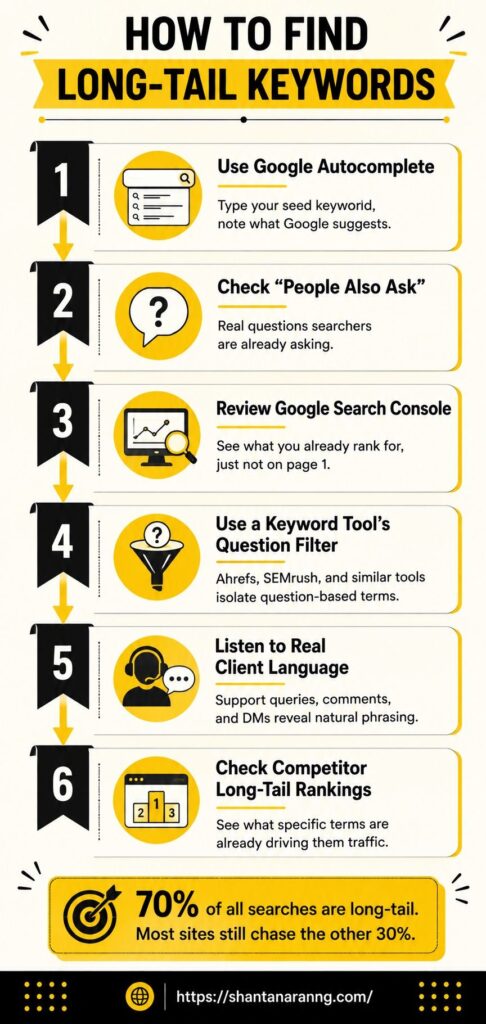
How to Find Long Tail Keywords
Finding long tail keywords does not require expensive tools to start. The best sources are often sitting in places most people ignore.
| # |
Method |
What it does |
| 1 |
Google Autocomplete |
Type your seed keyword, note what Google suggests |
| 2 |
People Also Ask |
Real questions searchers are already asking |
| 3 |
Google Search Console |
See what you already rank for, just not on page one |
| 4 |
Keyword Tool Question Filter |
Ahrefs, SEMrush, and similar tools isolate question-based terms |
| 5 |
Real Client Language |
Support queries, comments, and DMs reveal natural phrasing |
| 6 |
Competitor Long-Tail Rankings |
See what specific terms are already driving competitors traffic |
Use Google Autocomplete
To do the keyword mapping, type a seed keyword into Google and stop before hitting enter. The dropdown suggestions come from real searches people are already making. “SEO course” becomes “SEO course for beginners in Hindi,” “SEO course with certificate in India,” “SEO course fees in Delhi.” Each suggestion is a real long tail keyword with genuine search demand behind it.
Go further by adding a letter after the keyword. “SEO course a,” “SEO course b,” and so on. Each letter surfaces a different set of suggestions. This costs nothing and takes ten minutes.
Check People Also Ask
Every SERP for an informational query shows a People Also Ask box. These questions come directly from what real users searched for after entering the original query. They are almost always long tail, question-based, and carry clear informational intent.
Click one PAA question and the box expands, revealing more. Each expansion generates new ones. A single seed keyword can surface 30 to 50 distinct long tail question-based terms this way without opening a single paid tool.
Review Google Search Console Queries
The Performance report in Google Search Console shows every query your site has appeared for in the last 16 months, including ones you never intentionally targeted. Filter by queries with impressions but low clicks. These are often long tail terms where your page is appearing on page two or three.
A page already getting impressions for a long tail term is closer to ranking than a page targeting that term from scratch. Identify these, optimise the page for those queries, and the ranking improvement often comes faster than building a new page from zero.
Use a Keyword Tool's Questions Filter
Ahrefs, SEMrush, and most keyword research platforms let you filter results by question-based phrasing. Search a seed term in Ahrefs Keywords Explorer, apply the Questions filter, and you get thousands of long tail question-based variations sorted by volume and keyword difficulty.
Filter by KD under 20 and volume above 50 to get a practical working list. Export and check intent before assigning terms to pages.
Listen to Real Customer and Client Language
The most accurate long tail keywords or the type of search intent do not come from tools. They come from the actual words customers use when they describe their problem. Support tickets, WhatsApp messages, Instagram DMs, YouTube comments, and sales calls all contain phrases like “I need help getting my shop to show up on Google in Bangalore” or “how do I write product descriptions that rank.”
These are long tail keywords a tool will rarely surface early because they are too natural and too conversational for standard search data to catch. Keep a running document of phrases that appear repeatedly in customer communication. Many are queries that have not been heavily targeted yet, which means ranking for them is still realistic.
Check Competitor Long-Tail Rankings
Put a competitor’s domain into Ahrefs Site Explorer or SEMrush Domain Overview and filter for keywords they rank in positions 4 to 15. These are terms they appear for but are not fully optimising. Many will be long tail variations of their primary keywords, and a focused page can outrank a page that only incidentally covers that term.
This method also confirms demand that is already proven. If a competitor sits at position 8 for a long tail term, real traffic is there to take.
Don't Create One Page Per Long Tail Keyword
A common beginner mistake is treating every long tail keyword like it needs its own page.
“Best SEO course for beginners in India,” “affordable SEO course in India for freshers,” and “SEO course under 5000 in India” are three different long tail keywords but they all target the same intent. Here is what happens when you build separate pages for each:
Keyword clustering solves this. Group all related long tail terms with the same intent onto one well-structured page. That single page targets the primary keyword plus the full cluster of supporting terms, ranks for more queries, and builds authority faster than three thin pages ever would.
The keyword research guide covers how to build clusters before assigning any keywords to pages.
Conclusion
Long tail keywords are not the fallback option for sites that cannot compete on big terms. They are where actual, convertible traffic comes from for most sites that have not spent years building domain authority.
A beginner SEO site targeting “digital marketing” will spend years on page four. The same site targeting a cluster of long tail terms around “how to learn digital marketing at home for free in India” can be on page one within months, attracting visitors who are far more likely to read, subscribe, or buy than someone who typed two words into a search bar.
The search intent behind a long tail query is almost always clearer than behind a head term. Clearer intent means better content-to-query matching, which is what Google rewards. For anyone going through SEO for beginners or building a first content strategy, starting with long tail terms is not settling. It is the smarter move.
Ready to build a full keyword strategy from scratch?
FAQ’s on Long Tail Keywords
What are long tail keywords?
Long tail keywords are specific, multi-word search phrases with lower search volume and lower competition than broad head terms. They attract more targeted visitors and are easier to rank for on newer or smaller sites.
How many words make a keyword long tail?
Word count alone does not define it. A phrase is long tail when it is specific enough to signal clear intent and narrow enough to face lower competition, which usually means three or more words but is not a strict rule.
Are long tail keywords better for SEO?
For most sites that are not already dominant in their niche, yes. Lower keyword difficulty, higher conversion rates, and more realistic ranking timelines make them the practical starting point.
How do I find long tail keywords for free?
Google Autocomplete, People Also Ask boxes, and Google Search Console’s Performance report all surface long tail terms without any paid tool. AnswerThePublic also offers free searches for question-based variations.
Do long tail keywords convert better?
Generally yes. A searcher using a specific phrase already knows what they want and is further along in their decision than someone who typed a two-word query. That specificity is what drives the higher conversion rate long tail traffic consistently shows.


 WhatsApp