Most people building a site write about topics they assume their audience cares about. Some of it gets traffic. Most sits there for months with nothing to show for it, and there’s rarely an obvious reason why.
The content usually wasn’t the problem. Nobody searched for it. Or they did, but the page was in the wrong format for what they expected to find. SEO keyword research is what prevents both of those situations. It tells you what people are actually typing, how they phrase it, and what they want back when they do.
A page built around the right keyword in the right format will consistently beat a better-written page nobody searches for. Every time.
For anyone working through SEO for beginners, this is where the actual work starts. Not in writing, not in backlinks. Here.
Key Takeaways
Comprehensive Summary
Search intent: The same keyword can need a guide, a comparison post, or a product page depending on what the searcher actually wants.
Keyword mapping: Assigning one primary keyword per page before writing stops two pages from accidentally targeting the same query.
Competitor keyword research: Looking at what your competitors rank for shows you what your content plan is missing.
Not sure where to start with SEO?
Go from zero to a working keyword strategy in one structured course.
What is a keyword?
A keyword is any word or phrase someone types into a search engine. “Best SEO tools,” “how to fix a slow website,” “SEO course for beginners” are all keywords. Whatever your audience types when they’re looking for something you cover, that’s the keyword you want your page showing up for.
What is keyword research?
Keyword research is figuring out which search terms your audience actually uses, how many people search for them each month, and whether ranking for them is realistic given where your site is right now.
It tells you what to write before you open a doc, which format fits the query, and whether the keyword is winnable. Without it, content planning is mostly guesswork dressed up as strategy.
Types of keywords you need to know
Keywords aren’t all the same, and the type you target changes depending on where your site is, what the page is for, and how competitive the topic is.
Type | What it is | Example |
|---|
Seed keywords | The broad starting terms you feed into a research tool | “SEO,” “keyword research” |
Short-tail keywords | 1 to 2 words, searched a lot, fought over by everyone | “keyword research,” “SEO tools” |
Long-tail keywords | Longer, specific phrases that most sites ignore | “how to do keyword research for a new blog” |
LSI/related keywords | Words and phrases that naturally live around your main topic | “search volume,” “keyword difficulty,” “SERP” |
Branded keywords | Searches that include a company or tool name | “Ahrefs keyword explorer” |
Generic/non-branded | Topic searches with no brand attached | “best SEO tools,” “keyword research guide” |
New sites should spend most of their time on long-tail keywords. The competition is thinner, the person searching usually has a specific need, and a page that answers it well tends to convert at a higher rate than a broad term that pulls in traffic with no clear intent.
Understanding search intent
Search intent is what the user actually wants when they type a keyword. Two pages can target the same keyword and need completely different formats to rank. Google reads what users have historically clicked on and stayed with for any query, then surfaces more of the same.
Intent type | What the user wants | Content match |
Informational | To learn or understand something | Blog post, guide, FAQ page |
Navigational | To reach a specific site or page | Homepage, login page, brand page |
Commercial | To compare options before deciding | Comparison post, listicle, review |
Transactional | To take an action right now | Product page, service page, enrollment page |
Check intent before a keyword gets assigned to any page. The search intent guide shows how to read a SERP for intent in about five minutes.
Understanding search volume and keyword difficulty
Every keyword tool surfaces these two numbers. Together they decide which keywords are worth targeting now and which ones to park for later.
Search volume is how many times a keyword gets searched per month on average. More volume usually means more competition.
Keyword difficulty (KD) scores how hard it is to land on page one, from 0 to 100. The score reflects how authoritative the pages currently ranking there are.
How to use them together:
New sites should target KD under 20 to start. As the site builds authority through content and backlinks, more competitive terms become worth going after.
How to do keyword research, step by step
These steps work whether you’re starting a brand new site or adding to one that’s already live.
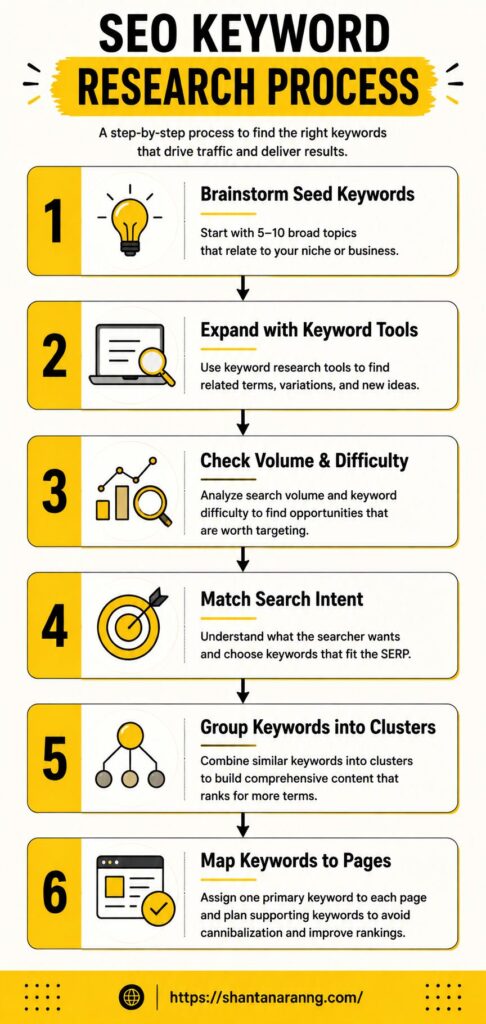
Step 1: Brainstorm seed keywords
Seed keywords are where everything begins. Pick 5 to 10 broad terms that describe your topic or business, and think about how your audience would describe their problem, not how you’d describe your service.
For an SEO site that might be “keyword research,” “on-page SEO,” or “backlinks.”
Don’t overthink this list. It’s just the raw material that goes into a tool next.
Step 2: Expand with keyword tools
Run those seed terms through Google Keyword Planner, SEMrush, or Ahrefs. Each one generates related terms, questions, and variations you wouldn’t have thought to search for manually. Pull what looks relevant into a spreadsheet: volume, KD, and any long-tail variations of your seed terms. Competitor terms that you don’t rank for are worth flagging separately.
The next step is where you cut the list down.
Step 3: Check search volume and difficulty
Cut the list down to targets that are realistic for your site’s current authority level.
A keyword with 100 monthly searches and KD of 4 will bring more traffic than a KD 85 term with 10,000 searches you’ll never reach page one for.
Step 4: Filter by search intent
Before any keyword gets assigned to a page, check what kind of content it actually needs.
Most beginner keyword lists get shorter here, which is the point. Fewer, better-matched pages will always outperform a large volume of pages pointing in the wrong direction.
Step 5: Group keywords into clusters
Keyword clustering means grouping related keywords onto one page rather than spreading them across several thin ones.
Five pages all targeting slight variations of the same query split any ranking signals across all five. One well-clustered page concentrates them.
Doing this for the first time?
Walk through the full keyword research process with real tools inside the course.
Best keyword research tools
Start free. Add paid tools once the free data stops covering what you need.
|
Tool
|
Best for
|
Free or paid
|
|
Google Keyword Planner
|
Volume data, starter keyword ideas
|
Free
|
|
Google Search Console
|
See which queries already bring traffic to your site
|
Free
|
|
Ubersuggest
|
Basic keyword research for beginners
|
Free tier available
|
|
SEMrush
|
Full keyword and competitor research platform
|
Paid, trial available
|
|
Ahrefs
|
Difficulty scores, backlink data, content gap analysis
|
Paid, trial available
|
|
AnswerThePublic
|
Question-based keyword ideas from search suggestions
|
Free tier available
|
Mapping keywords to pages
Keyword mapping is where the research connects to your actual site structure. Every page gets one primary keyword and a cluster of supporting secondary terms before writing starts.
It won’t replace building your own keyword list, but it shows you terms you wouldn’t have searched for on your own.
Want to see how your site stacks up against competitors?
A free audit shows exactly where the gaps are.
Common keyword research mistakes
These problems come from how people use the keyword list once they have it, not from misunderstanding the research itself.
Conclusion
Keyword research shapes every content decision that follows it. Each page gets a defined target, a matched format, and a realistic shot at ranking before writing begins. Without that foundation, content volume grows but traffic doesn’t move with it.
The cycle is: seed keywords, expand with tools, cut by difficulty and intent, cluster what’s left, map to pages. Then repeat as the site grows because the keyword landscape keeps shifting.
For anyone working through an SEO course for beginners, this is where the practical side actually starts. Get the keyword layer right and the rest of the process becomes a lot less guesswork.
Ready to build your first keyword strategy?
Learn keyword research alongside on-page SEO, technical basics, and content planning in one place.
FAQ’s on Keyword Research
What is keyword research in SEO?
Finding which search terms your audience uses, how often they search for them, and whether ranking for them is realistic on your site right now.
How do I find the right keywords for my website?
Start with seed keywords, run them through Google Keyword Planner or Ahrefs, filter by volume and KD, check the intent behind each one, then cluster related terms before assigning them to pages.
What is the difference between short-tail and long-tail keywords?
Short-tail keywords are broad one to two word phrases with high competition. Long-tail keywords are longer and more specific with lower competition, which makes them easier to rank for on newer sites.
Which keyword research tool is best for beginners?
Google Keyword Planner to start since it’s free and pulls data straight from Google. Move to Ahrefs or SEMrush when you need difficulty scores and competitor data.
How many keywords should I target per page?
One primary keyword, supported by a cluster of related secondary keywords that share the same topic and intent.


 WhatsApp