Healthcare SEO Case Study: Growing Traffic from 25K to 100K Monthly Visits
- Project Duration : Nov 2021 to Nov 2022

About Sprint Medical
Sprint Medical operates at the intersection of telemedicine and physical healthcare. The platform connects patients with doctors online across multiple specialities, runs a network of e-clinics in Indian cities, and offers home healthcare services including nursing care and diagnostic support.
The business model required two types of organic search to work: national visibility for online consultation queries and local visibility for each city-level e-clinic. That dual requirement shaped every SEO decision made during the engagement.
Challenges
Healthcare is one of the harder niches to rank in. Google classifies medical content under YMYL, which means the bar for content quality, author credibility, and site trustworthiness is higher than almost any other industry. A well-written article is not enough on its own.
The specific challenges at Sprint Medical were:
The website was new. The brand had no organic footprint. Everything had to be built from scratch.
- The telemedicine landscape was highly competitive. Platforms like Practo, Apollo 24/7 and Tata 1mg had a lot of domain authority and years of indexed content. To rank against them for high volume terms, it required a focused approach and not a broad one.
- YMYL trust signals. Google holds medical pages to a different standard than most other content. For Sprint Medical to rank on health-related queries, every page needed a named author with visible credentials, source citations that pointed to legitimate medical references, and content written at a level that matched the query's clinical context.
- Two separate SEO tracks. Online consultation pages needed national keyword targeting. E-clinic pages needed hyper-local SEO for each city. Running both simultaneously without cannibalising rankings or diluting crawl budget required careful page architecture.
- Converting traffic into consultations. Getting visitors to the site was only half the problem. The consultation booking flow needed to be accessible from content pages, not just the homepage or service pages that most organic visitors never saw.
Shanta’s SEO Strategy
Keyword Research and Segmentation
Keywords were split into three groups by competition level and timeline.
|
Bucket |
Type |
Target Timeline |
|---|---|---|
|
Short-term |
Low competition, mid-tail |
60 to 90 days |
|
Mid-term |
Condition and speciality specific |
3 to 6 months |
|
Long-term |
High volume head terms |
6 to 12 months |
Transactional queries got priority on service pages: “online doctor consultation India,” “consult dermatologist online,” “book GP appointment online.” Informational queries built out the blog and drove top-of-funnel traffic toward consultation CTAs through internal links.
Local keyword research was done city by city, not at the national level. A patient in Hyderabad searches differently than one in Delhi, so each e-clinic page was matched to the exact location-based queries patients in that area were typing into Google, including neighbourhood-level searches for nearby doctors.
Content Strategy
The content architecture was built around a symptom-to-solution structure. A patient searching “what causes recurring headaches” would land on a blog article that addressed the query properly, then be pointed toward an online neurology consultation through a contextual CTA within the content.
Each piece of content served a purpose in the funnel:
- Symptom articles pulled in patients early in their health concern journey
- Condition pages covered diagnosis, treatment options, and when to see a doctor
- Speciality service pages converted readers into consultation bookings
- Doctor profile pages were optimised with speciality-specific keywords to rank for searches like "best cardiologist online India"
New content went live consistently, with each article tied to a specific keyword target and a specific internal linking destination.
E-E-A-T Improvements
This was non-negotiable for a healthcare platform. Google’s quality guidelines are strict about medical content, and Sprint Medical needed to demonstrate genuine expertise, not just keyword coverage.
Actions taken to strengthen E-E-A-T:
- All medical content was tagged with doctor or healthcare professional authorship
- Author bio pages were built out with credentials, registration details, and professional backgrounds
- A medical review process was added so articles carried a "reviewed by" designation with the reviewer's qualification visible on the page
- Credible external citations were added throughout content to support factual claims
- The About page and Trust signals were strengthened with platform credentials, regulatory information, and patient volume data
Execution
Service Page Optimisation
Core service pages for each consultation speciality were rewritten from scratch. Title tags were rewritten with primary keywords near the front. Meta descriptions were written for click-through. H1 and H2 structures were aligned to the specific query intent for each page, not just the general service name.
Booking CTAs appeared at the top of service pages by default, but mobile scroll data told a different story. A large share of visitors were dropping off before they reached the bottom of the page. Mid-page prompts were added so someone halfway through reading about a speciality could book without scrolling further.
Local SEO for E-Clinic Pages
Each city-level e-clinic page was treated as a standalone SEO project:
- Unique title tags and meta descriptions for every location
- Locally relevant content covering the specific clinic, nearby landmarks, services offered at that location, and local doctor profiles
- Google Business Profile optimisation for each clinic, including category selection, service descriptions, photo uploads, and review management
- Local citation building in Indian business directories and healthcare listing platforms
- Schema markup using LocalBusiness and MedicalClinic structured data types
Technical SEO
Several technical issues were affecting crawl efficiency and indexation across the site.
- Crawl depth was reduced by restructuring internal links so important pages were reachable within three clicks from the homepage
- Duplicate content from URL parameters on appointment booking flows was resolved through canonical tags
- Page speed on mobile was improved across service and blog pages
- Structured data was added for medical organisations, FAQ sections, and individual doctor profiles
- Broken internal links accumulated from older content were identified and fixed
On-Page and Schema Enhancements
Schema markup was prioritised on pages where rich results could directly improve click-through rates:
- FAQ schema on condition and symptom pages
- MedicalCondition schema on disease-specific articles
- Physician schema on doctor profile pages
- LocalBusiness schema on e-clinic landing pages
Key Growth Driver
The local SEO build-out for e-clinic pages produced the highest return relative to the effort invested.
Most competitors in the digital health space were not doing proper local optimisation on individual clinic pages. The pages existed, but they were thin, templated, and essentially invisible to local search.
Replacing those with city-specific content, proper Google Business Profile management, and local citation building pushed rankings up quickly on “doctor near me” and clinic-specific searches.
The local work also had a direct conversion connection that national SEO does not always have. Someone searching for a GP in their neighbourhood is much closer to booking an appointment than someone reading a general health article. Getting in front of that intent produced measurable consultation growth faster than the broader content work.
Results
Year One (November 2021 to November 2022)
Metric | Nov 2021 | Nov 2022 |
|---|---|---|
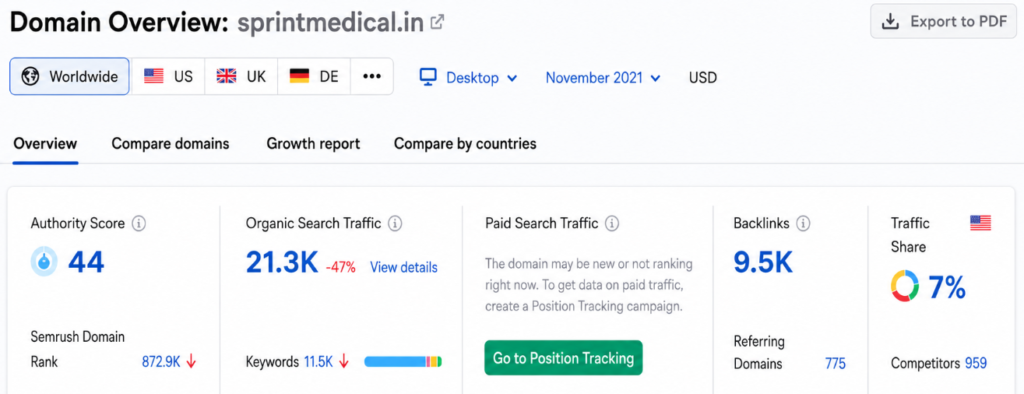
Monthly Organic Traffic | 25,000 | 100,000 |
Online Consultations/Month | 200 | 900 |
E-Clinic Calls/Month | 200 | 700 |
Organic Keywords | ~11,500 | ~45,500 |
Semrush Domain Rank | 872,900 | 219,200 |
Long-Term Cumulative Performance
GA (organic sessions) 1 Nov 2023 – 31 Oct 2024
- Over 16 months: 967,000 total clicks and 216 million impressions in Google Search Console
- November 2023 to November 2024: 950,908 organic sessions, contributing to over 1 million total sessions
- Year-over-year organic growth of 87.34% in the November 2023 to November 2024 period
- Organic search accounted for 87.34% of all sessions in the tracked annual period
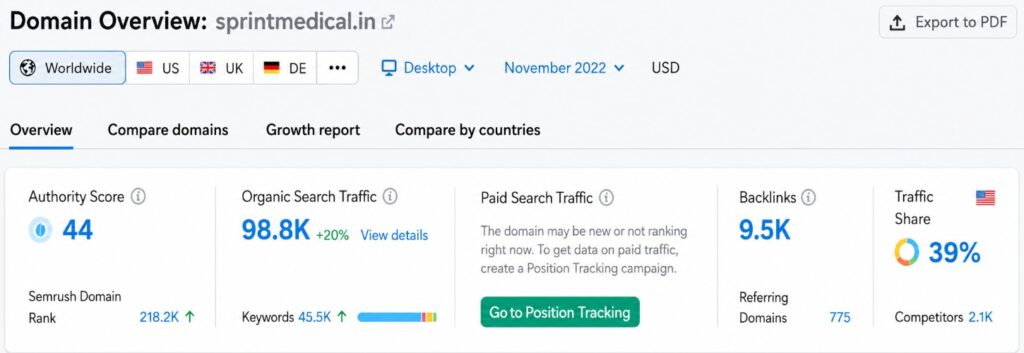
The consultation growth from 200 to 900 per month represented a 4x increase in a core revenue metric, not a traffic metric. That distinction matters for healthcare platforms where the business outcome is patient acquisition, not page views.
Conclusion
Sprint Medical’s growth came from treating healthcare SEO as two separate problems running at the same time: building national authority for telemedicine queries and building local relevance for clinic-specific searches. Neither track would have produced the same results alone.
The E-E-A-T work created the trust foundation that allowed content to rank. The keyword segmentation meant the site targeted terms it could actually win in the short term while building toward more competitive queries over time. The local SEO work connected organic search directly to appointment volume in a way that national content cannot replicate.
Healthcare SEO requires a higher standard of execution than most niches. Getting it right takes time, but the compounding effect on patient acquisition is significant.
If you run a healthcare platform, a clinic network, or a telemedicine service and organic search is not driving patient inquiries at the level your business needs, get in touch.
Reach out at contact@shantanarang.com, visit shantanarang.com, or connect on LinkedIn at linkedin.com/in/seowithshanta.
 WhatsApp