Every time you search for something on Google, results appear in less than a second. But how do search engines work behind that speed? The answer involves three stages, crawling, indexing, and ranking, and none of them happens in real time. Search engines don’t scan the live web when you type a query. They pull results from a pre-built database assembled days or weeks before your search. How search engines work, how search engines work, and why some pages show up on page one while others never appear at all comes down to how well a site performs across each of these three stages.
A structured SEO roadmap cuts through that. Instead of learning everything at once, you follow a sequence where each phase builds on the last. Fundamentals come before keyword research. Keyword research comes before on-page. On-page before technical. When the order is right, things start connecting faster and staying longer. This seo step by step guide is written for complete beginners, so let’s begin.
Comprehensive Summary
Key Takeaways
Not sure where to start?
Get a personalised SEO roadmap built around your site.
Why You Need an SEO Roadmap
Random learning is the most common reason beginners stall. They read about backlinks before they understand how search engines work. They try to fix Core Web Vitals before they’ve published a single optimised page. The knowledge doesn’t stack because the order is wrong.
An seo learning roadmap solves this by giving you a sequence. SEO for Beginners starts with a foundation, and that foundation is what makes every topic that follows easier to absorb. You also spend less time on advanced topics that won’t matter until the basics are down. Progress feels real because you move through phases instead of an endless list.
How Long Does It Take to Learn SEO?
There’s no single answer, but the timeline below reflects what most consistent learners experience.
|
Timeframe
|
What you can realistically do
|
|
1 month
|
Grasp SEO fundamentals, understand how search engines work, learn core terminology
|
|
3 months
|
Complete keyword research, on-page SEO, and basic technical SEO
|
|
6 months
|
Publish optimised content, build initial links, read analytics reports
|
|
12 months
|
Run full audits, manage campaigns, and move into advanced topics
|
Consistency matters more than speed. Thirty focused minutes daily beats a four-hour weekend session that happens twice a month.
SEO Learning Roadmap
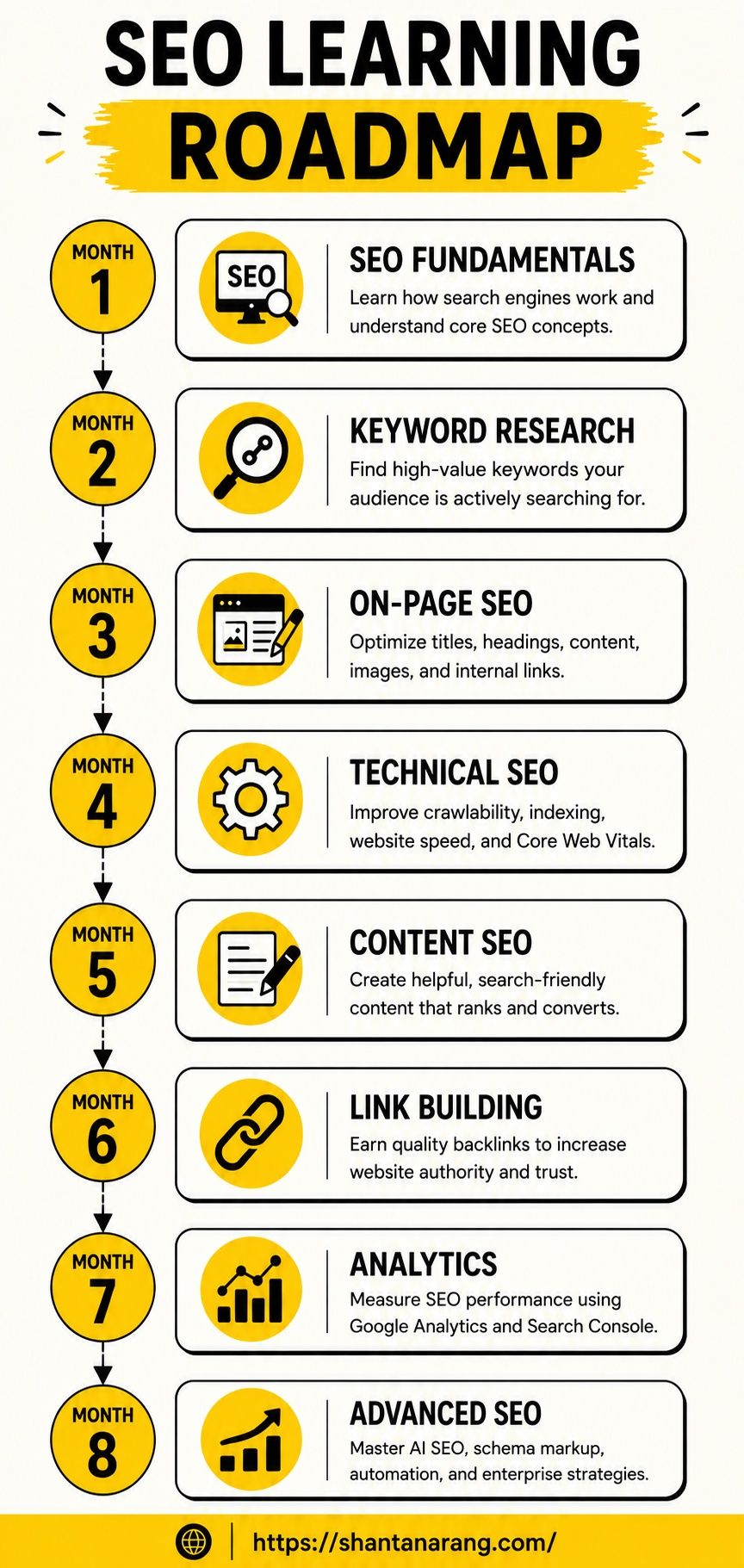
This seo learning roadmap runs in sequence for a reason. Fundamentals before keywords. Keywords before content. Content before links. The order isn’t arbitrary; it reflects how SEO actually compounds.
Phase 1: Learn SEO Fundamentals
Start here before anything else. Understand what is SEO, why it matters, and how search engines work at a basic level. Read Google’s own Search documentation. Get comfortable with an SEO Terminology Guide so words like crawling, indexing, SERP, and authority stop sounding foreign. Here are the topics to cover:
Phase 2: Master Keyword Research
Most beginners write content first and check keywords later. That’s backwards. Know what your audience searches and why before a single word goes on the page. Then assign those terms to the right pages.
Phase 3: Learn On-Page SEO
Every page has a title tag, meta description, URL, and headings. This phase teaches you how to write each one clearly so Google knows exactly what the page covers.
Phase 4: Technical SEO
This phase covers crawling, indexing, sitemaps, robots.txt, and Core Web Vitals. No coding needed, just knowing what each element does and where to check it.
Phase 5: Content SEO
Publishing pages that match search intent beats publishing pages that just hit a word count. This phase covers helpful content, content planning, and topic clusters.
Phase 6: Link Building
Links from other sites build authority. This phase covers what makes a backlink valuable, how domain authority works, and outreach basics. Buying links risks a Google penalty.
Phase 7: Analytics and Reporting
Numbers without context are noise. This phase teaches you to read Google Search Console and Google Analytics and turn what you see into actual decisions.
Phase 8: Advanced SEO
Programmatic SEO, AI SEO, international SEO, e-commerce SEO, and entity SEO all live here. Tackle this phase only after the earlier seven are working on a real site.
Not Sure Which Phase You're Stuck On?
A quick audit shows exactly where your site is losing ground.
SEO Tools Every Beginner Should Learn
Start with Google Search Console and Google Analytics. Both are free and give you the clearest picture of how your site is performing.
Tool | Purpose |
|---|
Google Search Console | Track indexing, crawl errors, and search performance |
Google Analytics | Measure traffic, behaviour, and conversions |
Google Keyword Planner | Find keyword volume and competition data |
Ahrefs | Backlink analysis, keyword research, site audits |
Semrush | All-in-one SEO platform for research and tracking |
Screaming Frog | Crawl your site to find technical issues |
Practical SEO Learning Tips
Theory alone won’t get you far in this beginner seo guide. Practice separates people who understand SEO from people who can actually do it.
The seo learning journey accelerates when theory gets tested immediately rather than saved for later.
Common Mistakes Beginners Make
The seo checklist for beginners only helps if you’re actually ticking things off on a live project.
Conclusion
SEO has a reputation for being complicated, but the subject itself isn’t the hard part. Learning seo without a structure is. Follow an seo learning guide that moves in sequence, practice on something real from the beginning, and give each phase enough time before moving to the next. How to become an seo expert is less about talent and more about consistency applied in the right order.
Ready to Start?
Get a free SEO audit and see exactly what needs to be fixed.
FAQ’s on SEO Roadmap for Beginners
What is an SEO roadmap?
A structured plan that tells you which SEO topics to learn, in what order, and what to do with that knowledge on a real website.
How do beginners learn SEO?
Start with how search engines work and basic terminology. Then move through keyword research, on-page, and technical SEO in sequence. Practice on an actual site throughout, not after.
Can I learn SEO by myself?
Yes. Google’s own documentation covers most of what you need. Pair that with a real website to test on and you don’t need a course to get started.
How long does SEO take to learn?
Fundamentals take about a month. Running a campaign independently takes closer to six months. Twelve months of consistent practice gets most people to a point where results become predictable.
Which SEO topic should I learn first?
What is SEO and how search engines work. Keyword research and on-page optimisation make little sense without that base.
Which SEO tools should beginners use?
Google Search Console and Google Analytics cover the essentials and both are free. Add Screaming Frog once you’re ready to look at technical issues, then Ahrefs or Semrush when the fundamentals are solid.
Do I need coding to learn SEO?
No. Knowing what a title tag or canonical tag does matters more than being able to write one from scratch in HTML. Basic familiarity helps but coding is not a requirement.
How can I become an SEO expert?
Work through a structured seo skills roadmap, apply everything to real sites, and document what you test and what changes. Expertise builds from repeated practice, not from reading more articles.

 WhatsApp