A page can be technically clean, keyword-optimised, and well-written, and still sit on page four for every query it targets. In most cases, the reason isn’t the content quality. It’s that the content doesn’t match what the person searching actually wanted.
Search intent is what Google uses to determine whether your page deserves to rank for a given query. When someone types “best SEO trainer in India,” they want a comparison, not a biography. When someone types “what is search intent,” they want a clear explanation, not a sales page. Google has become very good at reading the difference, and it rewards pages that match what users want with the format they expect.
Understanding search intent is where keyword research stops being a volume exercise and starts becoming a content strategy. Targeting a keyword with high volume but the wrong intent produces a page that Google won’t rank regardless of how many times the keyword appears. This is one of the first things covered in any serious SEO for beginners resource, because getting it right from the start removes one of the biggest reasons content underperforms.
This guide covers what search intent is, how the four types work in practice, how to determine intent for any keyword before writing, and what the rise of AI search means for how intent gets matched in 2026.
Comprehensive Summary
- Search intent: Search intent is the underlying goal behind a search query, and Google prioritises it above almost every other ranking signal when deciding which pages belong at the top.
- Informational intent: Users with informational intent want to learn something: a definition, an explanation, a how-to, or an answer to a specific question.
- Navigational intent: Users with navigational intent already know where they want to go and are using Google to get there faster than typing the full URL.
- Commercial intent: Users with commercial intent are in research mode, comparing products, services, or options before making a final decision.
- Transactional intent: Users with transactional intent are ready to act now: buy, sign up, book, or download, and they need a page that makes that action easy.
- AI search and intent (2026): AI Overviews are absorbing informational queries directly in the SERP, which changes what "ranking" means for educational content and makes intent-matching more precise than ever.
Key Takeaways
- Search intent is the primary signal Google uses to decide which content format belongs on page one for any query
- The four types of search intent, informational, navigational, commercial, and transactional, each require a different content format and approach
- Matching user intent seo correctly before writing a single word is more likely to produce rankings than optimising a page that targets the wrong intent
Want to learn SEO properly?
Learn how to find keywords, read search volume, and map them.
What is search intent?
Search intent is the goal behind a query. It’s what the user wants to find, do, or reach when they hit enter, and it’s what Google uses to decide which type of page belongs at the top of results.
Google doesn’t just match keywords. It reads the intent those keywords signal. Two queries can share the same topic and need completely different pages to satisfy them:
- "how to fix a noindex tag" wants a step-by-step guide
- "Screaming Frog pricing" wants a pricing or comparison page
Google identifies dominant intent by tracking what users click, how long they stay, and whether they search again after visiting a page. That behaviour data shapes what appears on page one. A page that deviates from the format Google expects, regardless of how well-written or technically optimised it is, will struggle to hold a ranking.
For anyone starting out, search intent is covered early in every serious SEO for beginners resource because it determines the format before anything else does.
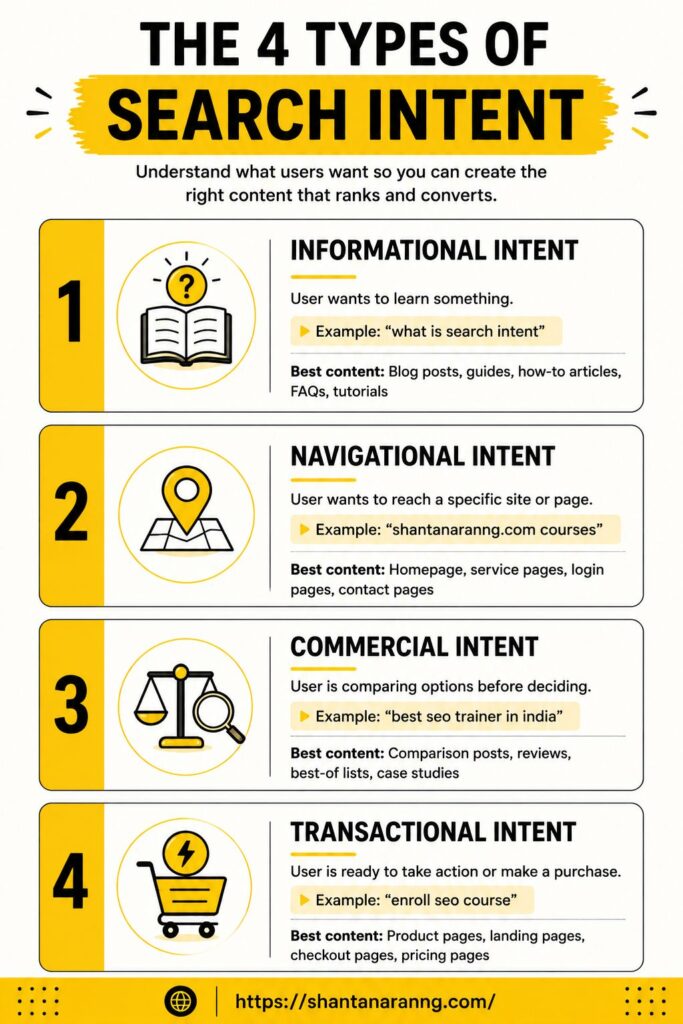
The 4 types of search intent
Every search query falls into one of four categories. The table below has all the types of search intent:
Intent type | What the user wants | Example query | Best content format |
|---|---|---|---|
Informational | To learn or understand something | “what is search intent” | Blog post, guide, FAQ |
Navigational | To reach a specific site or page | “Google Search Console login” | Homepage, login page |
Commercial | To compare before deciding | “best SEO tools for beginners” | Comparison post, listicle |
Transactional | To take an action right now | “enroll SEO course online” | Landing page, product page |
Informational intent
People searching with informational intent just want to learn something. No purchase decision, no specific website in mind. So, your keyword research must include:
- Typical modifiers: "what is," "how to," "why," "guide," "explained"
- Winning format: blog post or guide with clear headings and examples
- Example query: "what is search intent in SEO"
Google puts long-form guides and explainers at the top for these queries. A product page won’t show up here because the user isn’t anywhere near a buying decision, and Google reads that clearly from how people interact with results.
Navigational intent
Users already know where they’re going. They’re using Google as a faster path to a specific page, brand, or tool.
- Typical signals: brand names, tool names, "login," "pricing," "official site"
- Winning format: the actual destination page, whether that's a homepage, login page, or pricing page
- Example query: "Ahrefs keyword explorer" or "shantanaranng.com courses"
Third-party content rarely ranks for navigational queries. The user wants a specific destination, not a roundup. Navigational intent matters most for brand protection. If a competitor ranks above your own brand name in search, that’s an issue worth addressing.
Commercial intent
Users are in research mode. They know roughly what they want but haven’t committed yet. They’re comparing, reading reviews, or weighing up options.
- Typical modifiers: "best," "top," "vs," "review," "alternatives"
- Winning format: comparison posts, ranked lists, detailed reviews
- Example query: "best SEO trainer in India" or "Ahrefs vs Semrush"
A product page won’t rank here because it’s too pushy. A definition post won’t rank here because it’s too basic. Commercial intent sits between the two, and the content needs to reflect that research stage. These queries are high-value ranking targets because users are close to a decision.
Transactional intent
Users are ready to act. Buy, enroll, book, download, contact. The decision is made and they need a page that makes the action straightforward.
- Typical modifiers: "buy," "enroll," "hire," "get," "near me," "download"
- Winning format: product page, course enrollment page, service landing page with a direct CTA
- Example query: "enroll SEO course" or "hire SEO specialist"
Educational content doesn’t rank here. A user with transactional intent doesn’t want more information. They want a clear next step and a way to take it.
Want to map keywords to the right intent before you write?
Learn how intent fits into your full research process.
How to determine search intent for any keyword
Don’t guess. The SERP tells you exactly what intent Google has assigned to any query. Work through these steps before writing anything.
Search the keyword, short tail or long tail keyword in incognito. Look at what dominates the first five results
- Guides and blog posts = informational
- Comparison lists = commercial
- Product or enrollment pages = transactional
- Brand homepages = navigational
Check the content format that’s ranking. If the top results are all “how to” guides, a product page targeting the same keyword won’t rank. Match the format that’s already winning, not the format you prefer.
Read the query modifiers:
- "how," "what," "why," "guide" points to informational
- "best," "top," "vs," "review" points to commercial
- "buy," "hire," "enroll," "near me" points to transactional
- Brand or tool names alone points to navigational
Check People Also Ask. The questions Google surfaces here show related sub-intents. All definitional PAA questions confirm informational. Comparative questions confirm the commercial. They also give natural heading ideas for the content.
Read the titles and URLs of top results:
- "What is" or "How to" in titles = informational
- "Best" or "Top 10" = commercial
- Short action-oriented titles = transactional
This process takes five minutes per keyword and removes the most common cause of content that underperforms despite solid writing. Apply it during keyword research and again during keyword mapping when assigning topics to specific URLs.
Search intent examples
The table below applies intent analysis to six real queries across all four types.
Query | Intent type | Why |
|---|---|---|
“what is search intent” | Informational | Asking for a definition, user wants to learn |
“how to determine search intent for a keyword” | Informational | “How to” modifier confirms a process-based answer is needed |
“Google Search Console login” | Navigational | User knows the tool and wants the login page directly |
“best keyword research tools for beginners” | Commercial | “Best” signals comparison, not a purchase decision yet |
“Ahrefs vs Semrush” | Commercial | Direct comparison, user is deciding between two known options |
“enroll SEO course for beginners“ | Transactional | “Enroll” is a clear action word, user is ready to sign up now |
None of these are ambiguous once you apply modifier and format logic. The intent type is visible in the phrasing before you open a browser.
Why search intent matters more than keyword volume
High search volume means nothing if the intent behind the keyword doesn’t match what the page delivers.
- A keyword with 10,000 monthly searches and the wrong intent produces a page Google won't rank
- Users who land on a mismatched page bounce fast, and that bounce signal actively damages rankings over time
- Volume tells you how many people are searching; intent tells you what they need when they arrive
Search intent seo isn’t a separate step from keyword research. It’s embedded in every keyword decision. “SEO salary” can carry informational intent (“what does an SEO earn?”) or commercial intent (“compare SEO agency pricing”) depending on the full phrase. The surrounding words determine the intent, and the intent determines the format.
Matching intent first, before writing and before optimising, gives every page a realistic chance of ranking. Targeting volume without checking intent produces content that sits ignored regardless of how technically clean the page is.
Search intent in the AI search era (2026)
AI Overviews have changed how informational intent queries get answered in the SERP. This is the biggest structural shift to search results in recent years.
What has changed:
- Informational queries now often get a generated answer at the top of the SERP, pulling from multiple sources
- Users may read the AI summary without clicking through to any individual page
- Ranking for informational intent now partly means appearing inside the generated response, not just in a blue link below it
What this means for content:
- Short, direct answers in the opening lines of each section improve the likelihood of being extracted
- Clear heading structure and well-formatted FAQs make content easier for Google's systems to pull from
- Thin or vague explanations get passed over in favour of pages that answer precisely and quickly
What has not changed:
- The four types of search intent remain the same
- Commercial and transactional queries are less affected because a generated summary doesn't replace visiting a comparison page or an enrollment landing page
- Matching ai search intent still starts with identifying which of the four types applies to the query
The shift is specific to informational content. Pages that want to appear in AI Overviews need to be built for extraction, precise, structured, and direct, not just for traditional ranking signals.
Want to see how your site stacks up against competitors?
A free audit shows exactly where the gaps are.
Book a Free SEO Audit
Fill the form to get in touch.
Common keyword research mistakes
These problems come from how people use the keyword list once they have it, not from misunderstanding the research itself.
- Chasing the biggest volume numbers without checking KD. A high-volume keyword on a site with no authority produces nothing.
- Assigning a keyword to the wrong content format. Even a well-optimised page won't rank if it doesn't match what the SERP is showing for that query.
- Trying to rank every variation on a separate page. That splits the ranking signals that should be sitting on one stronger page.
- Running keyword research once and never revisiting it. Search behaviour changes. Old pages go stale. New competitors appear. The list needs refreshing regularly.
- Writing off low-volume, low-KD terms. On a newer site, a KD 4 keyword with 80 monthly searches will outperform a KD 72 keyword with 8,000 for a long time.
Conclusion
Search intent is the decision that happens before any word of content gets written. It determines the format, the depth, and the type of page that has a realistic chance of ranking for any given keyword.
Getting it right means:
- Running SERP analysis before drafting anything
- Matching the format Google already rewards for that query
- Revisiting intent first whenever a page isn't performing, before assuming it's a technical or backlink problem
The content that ranks consistently isn’t always the longest or the most optimized. It’s the content that gives the user exactly what they came for, a concept that remains the foundation of any effective SEO course for beginners.
FAQ’s on Search Intent in SEO
What is search intent in SEO?
Search intent is the underlying goal behind a query and the primary signal Google uses to decide which page format belongs at the top of results.
What are the 4 types of search intent?
Informational (to learn), navigational (to reach a specific site), commercial (to compare before deciding), and transactional (to act now).
How do I find the search intent of a keyword?
Search the keyword in incognito, look at the format of pages ranking in the top five, and read the query modifiers. The SERP tells you exactly what intent Google has assigned.
Can a keyword have more than one search intent?
Yes. Some keywords carry mixed intent. When that happens, the dominant format in the top five positions tells you which intent to prioritise.
Does AI search change how search intent works?
The four intent types haven’t changed, but AI Overviews now handle many informational queries inside the SERP directly, so informational content needs to be structured for direct extraction rather than traditional ranking alone.
ABOUT AUTHOR

Shanta Narang
Shanta Narang is an SEO consultant and digital marketing specialist with over 15 years of experience helping brands build strong online visibility. As an SEO expert in India, she focuses on delivering structured SEO services, content writing services and user-focused digital strategies.
BLOG CATEGORIES
RECENT POSTS


 WhatsApp