Search engine optimisation has grown from a niche technical skill into one of the most sought-after disciplines in digital marketing. Businesses across every industry need people who understand how organic search works, and that demand has outpaced the supply of trained professionals for several years running.
An SEO career today doesn’t look like it did a decade ago. The role has broadened. SEO professionals now work at the intersection of content strategy, data analysis, technical problem-solving, and user experience. Agencies hire them to manage client accounts. Startups hire them to build organic channels from nothing. Enterprises hire them to protect and grow visibility at scale. And a growing number of people are building SEO freelancer careers, working independently across multiple clients and industries.
This guide covers everything someone starting out needs to know: what an SEO professional actually does day to day, how the career path progresses stage by stage, what skills and tools matter, what the salary picture looks like across different roles, and how to avoid the mistakes that slow most beginners down. Whether you’re a student, a career switcher, or someone already in digital marketing who wants to specialise, this guide maps the full SEO career path from the beginning.
Key Takeaways
- A career in SEO offers genuine remote work flexibility, strong salary growth as you progress, and demand that spans agencies, startups, and enterprises globally
- Building an SEO career requires practical experience on real projects, not just theoretical knowledge from courses or videos
- SEO job roles range from junior executive to consultant and manager, with specialisations in technical, content, local, and enterprise SEO available at mid and senior levels
Comprehensive Summary
- SEO career SEO careers span multiple industries and work environments, with demand growing consistently as businesses compete harder for organic search visibility
- SEO career path The path moves through six stages: learning fundamentals, practising on real sites, building a portfolio, landing entry roles, specialising, and eventually moving into consulting or management
- SEO skills Technical skills like keyword research, analytics, and HTML basics sit alongside soft skills like communication, critical thinking, and client management
- SEO salary Salaries vary by role and experience; entry-level SEO executive roles start lower but senior specialists, managers, and consultants earn significantly more
- SEO certifications Google, HubSpot, Semrush Academy, and Ahrefs Academy all offer certifications that carry weight during job applications, particularly for freshers with no professional experience
- SEO career opportunities Opportunities exist in agencies, in-house teams, startups, enterprises, and freelancing, giving SEO professionals more career flexibility than most digital marketing disciplines
Not sure where to start with SEO?
Get a personalised learning plan built around your current skill level.
Why choose SEO as a career?
Organic search consistently brings in higher-converting traffic than most other digital channels, which is why demand for SEO professionals stays steady even when marketing budgets tighten. Paid advertising stops delivering the moment the spend stops.
SEO-driven traffic doesn’t work that way. The rankings and authority built over months continue generating visits without ongoing ad spend behind them, which is exactly why businesses treat SEO as a long-term investment rather than a line item to cut first.
The SEO career also suits people who prefer working remotely. A large share of SEO roles, both employed and freelance, are location-independent. The work happens in browsers, dashboards, and documents, not on-site.
Career | Demand | Growth | Remote-friendly |
|---|---|---|---|
SEO | High | Strong | Yes |
PPC/Paid Media | High | Moderate | Yes |
Social Media Marketing | High | Moderate | Yes |
Web Development | Very High | Strong | Yes |
Graphic Design | Moderate | Stable | Yes |
The arrival of AI tools in search has added a new layer to the role rather than replacing it. Understanding how AI-generated search features work, and how to optimise content to appear within them, has become part of what an SEO professional handles. People who learn SEO now enter a field that keeps evolving, which suits anyone who finds static job descriptions unstimulating.
What does an SEO professional do?
The day-to-day work of an SEO professional varies by role level and employer type, but certain responsibilities appear across almost every position:
- Keyword research: identifying what target audiences search for, evaluating competition and volume, and mapping keywords to the right pages across a site
- Technical audits: crawling a site to find broken links, indexing errors, slow pages, duplicate content, and missing metadata, then generating a prioritised list of fixes
- Content optimisation: reviewing title tags, headings, meta descriptions, and body content on both new and existing pages to align them with target keywords and search intent
- Reporting and analytics: tracking keyword rankings, monitoring traffic in Google Analytics, reviewing crawl data in Google Search Console, and presenting findings to clients or internal stakeholders
- Cross-team collaboration: working with developers, content writers, designers, and marketing managers to get SEO recommendations implemented, since most fixes require other teams to act on them
SEO career path
Building an SEO career follows a fairly consistent progression, even if the timeline differs by person. The six stages below reflect how most practitioners move from beginner to senior professional.
Stage 1: Learn SEO fundamentals
Before anything else, get clear on what is SEO, how search engines work at a structural level, and the vocabulary the field runs on. Work through an SEO Terminology Guide so terms like canonical tags, crawl budget, and search intent have solid meanings before you meet them in a live project. Recommended starting points are:
- Google Search Central for crawling, indexing, and ranking documentation straight from the source
- Shanta's SEO course for a structured, beginner-friendly path through every phase in the right order
- An SEO roadmap to keep your learning sequential rather than scattered across random topics
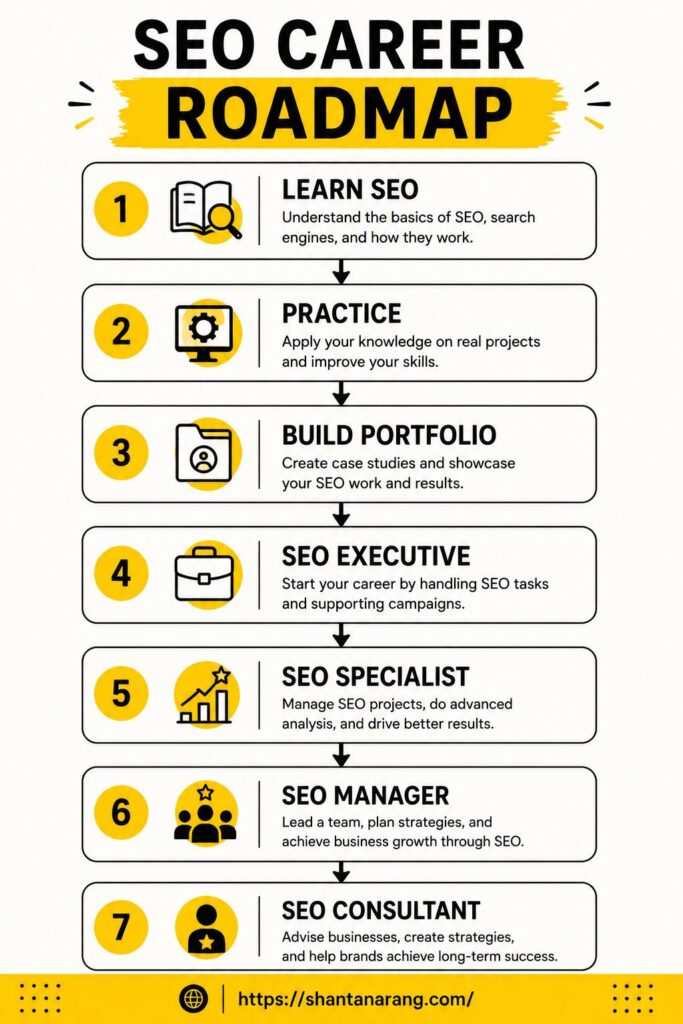
Stage 2: Practice SEO
Theory without application doesn’t build real skill. Set up a personal website or blog and treat it as a testing ground. Optimise pages, track rankings, fix technical issues, and publish content with a target keyword in mind. The mistakes you make on your own site cost nothing and teach faster than any course.
Practice projects don’t need to be impressive. A personal blog with ten optimised posts and clean technical structure is enough to start understanding how ranking decisions actually work in practice.
Stage 3: Build an SEO portfolio
A portfolio is what separates candidates in a hiring process. It doesn’t require professional client work. Case studies from your own site work well, provided they show real data: before and after rankings, traffic growth over a period, technical issues found and resolved, or content that gained impressions in Google Search Console.
Include full site audits you’ve completed, keyword research documents, and any ranking improvements you can attribute to specific changes. Screenshots from Google Search Console with clear timelines carry real weight.
Stage 4: Apply for SEO jobs
Entry-level SEO jobs for freshers include internships, junior SEO executive positions, and content assistant roles with SEO responsibilities. Internships at agencies are particularly good early placements because the exposure to multiple client accounts accelerates learning faster than most in-house junior roles.
Freelance opportunities are also available early. Small local businesses, startups, and bloggers often need basic SEO help and are open to working with less experienced practitioners at lower rates. This builds the portfolio while generating income.
Stage 5: Become an SEO specialist
After one to two years of hands-on work, most practitioners start specialising. The main directions are technical SEO, content SEO, local SEO, and enterprise SEO. Each requires a different skill emphasis.
Technical SEO covers the infrastructure side, architecture, JavaScript rendering, Core Web Vitals, and log files. Content SEO is about planning what to publish, grouping topics into clusters, and writing for search intent.
Local SEO manages Google Business Profiles, citation accuracy, and geo-targeted landing pages. Enterprise SEO applies all of this at a scale where technical complexity and internal politics are as much a part of the job as the SEO itself.
Specialisation is what drives salary growth. Generalist SEO knowledge gets you hired; specialist depth gets you paid more and taken more seriously.
Stage 6: Become an SEO consultant or manager
Senior SEO careers shift toward strategy and business impact rather than execution. An SEO manager leads a team, owns the direction of SEO programmes, and reports into marketing leadership. An SEO consultant, whether independent or agency-side, advises on strategy and oversees implementation without handling the day-to-day work directly.
Both paths require client handling skills, the ability to communicate SEO value to non-technical stakeholders, and enough business acumen to connect SEO activity to revenue rather than just rankings.
Essential SEO skills you need
SEO skills fall into two categories. Technical skills define what you can do with data and tools. Soft skills define how effectively you work with clients, teammates, and stakeholders.
Technical skills | Soft skills |
|---|---|
Keyword research | Communication |
Technical SEO | Problem-solving |
Analytics and data interpretation | Critical thinking |
Content strategy | Presentation |
HTML basics | Client management |
HTML knowledge doesn’t mean writing code from scratch. It means reading a page’s source, understanding how title tags and heading tags are structured, and knowing enough to brief developers accurately. Most SEO work doesn’t require coding, but basic familiarity with HTML removes a real bottleneck in how to become an SEO expert.
Analytics is increasingly central to the role. The ability to pull data from Google Analytics and Search Console, interpret what it means, and make decisions from it separates practitioners who grow from those who stay in place.
SEO tools every professional should learn
Tools are where SEO knowledge becomes executable. The table below covers what every SEO professional should be comfortable using.
Tool | Purpose |
|---|---|
Google Search Console | Track indexing status, search performance, crawl errors |
Google Analytics | Measure traffic, user behaviour, and conversions |
Google Keyword Planner | Research keyword volume and competition |
Ahrefs | Backlink analysis, keyword research, content gap analysis |
Semrush | All-in-one SEO platform for audits, tracking, and research |
Screaming Frog | Crawl websites to identify technical issues at scale |
Start with Google Search Console and Google Analytics. Both are free, both are used in every SEO role regardless of seniority, and they give the most direct view of how a site performs in search. Add Screaming Frog once you’re ready to run your first proper technical audit.
SEO salary and career opportunities
SEO salary varies significantly by role, experience level, location, and whether the work is employed or freelance. The figures below reflect general ranges for the Indian market, with global figures varying considerably upward for US, UK, and Australian markets.
Role | Approximate annual salary (India) |
|---|---|
SEO Executive (fresher) | ₹2.5L – ₹4L |
SEO Specialist (2–4 years) | ₹4.5L – ₹8L |
SEO Manager (5+ years) | ₹8L – ₹18L |
SEO Consultant (independent) | ₹10L – ₹30L+ |
SEO Freelancer | Variable, project-based |
SEO executive salary at entry level is modest in most markets, but it grows quickly with demonstrated results. SEO expert salary at senior and consultant levels reflects the direct revenue impact the role can have, which is why specialists who can prove measurable business outcomes earn considerably more than those who report rankings alone.
SEO career opportunities span agency work, in-house roles at brands of every size, startup environments, and fully independent freelance practices. The variety of settings means the SEO career path doesn’t force people into one type of environment long-term.
Agency vs freelancing vs in-house SEO
Each work environment has a different character, and the right choice depends on what stage of the career path you’re at and what you’re optimising for.
Factor | Agency | In-house | Freelance |
|---|---|---|---|
Learning speed | Fast (multiple clients) | Moderate (one industry) | Variable |
Salary | Moderate entry, grows | Often higher mid-senior | Uncapped but inconsistent |
Flexibility | Low to moderate | Low | High |
Growth path | Clear progression | Depends on company size | Self-directed |
Stability | Moderate | High | Low to moderate |
Agency work suits early-career professionals because the volume and variety of client work builds skills faster than most in-house roles can. In-house suits people who want depth in one industry and more stable working conditions. An SEO freelancer career suits practitioners who have enough skills and contacts to generate their own business and prefer autonomy over structure.
Certifications that can boost your SEO career
SEO certifications don’t replace practical experience, but they carry genuine weight when applying for SEO jobs for freshers with limited professional history. The following are the most recognised.
- Shanta Narang’s SEO courses (paid, structured curriculum suitable for beginners)
- Google Search Console and Analytics certifications through Skillshop (free, widely recognised by employers)
- HubSpot SEO Certification (free, covers fundamentals and content strategy)
- Semrush Academy (free courses across technical SEO, keyword research, and content)
- Ahrefs Academy (free, particularly strong on keyword research and link building)
An SEO course from any of these platforms adds credibility to a portfolio, particularly when the certification comes with a completed project or audit rather than just a completion badge.
Want hands-on SEO training?
Practice-based modules with real audits, real tools, and real results.
Common mistakes beginners make
Most early-career mistakes in SEO come from how the learning is approached rather than from a misunderstanding of individual concepts.
- Months of reading and note-taking with no actual website to test things on means you never really learn, you just accumulate information
- Technical SEO looks scary so most beginners skip it, then wonder why their pages aren't showing up in search
- Without a portfolio, you're walking into interviews with nothing to show except course certificates and a list of things you've read
- Buying cheap backlinks or stuffing keywords into every paragraph might move the needle briefly, but Google catches on and the damage takes time to undo
- YouTube is fine for getting started, but if Google's own documentation isn't part of your routine, you'll hit gaps that show up the moment a real problem lands in front of you
- Not opening Google Search Console in the early weeks means you're flying blind on how Google sees your site, and you won't know something's wrong until it's been wrong for a while
The SEO for beginners phase is where habits form. Practical implementation from the start, even on a personal blog, builds better instincts than any amount of passive consumption.
Is SEO a good career in 2026 and beyond?
AI tools changed content production, and AI Overviews reshaped how search results display. A lot of people assumed that meant fewer SEO jobs. Hiring data since then tells a different story.
Search got more competitive, not less. Businesses now need practitioners who understand how AI-generated features work, what E-E-A-T signals actually require from a content and credibility standpoint, and how to keep large sites technically sound in environments that are more demanding than they were three years ago. The scope of the role grew.
What that looks like in practice:
- Optimising for AI Overviews and featured snippets requires a different content structure than standard blue-link ranking did
- E-E-A-T compliance pushes teams to think about author authority, sourcing, and factual accuracy rather than keyword density alone
- Technical complexity on modern sites has increased, which means technical SEO skills carry more value, not less
- Remote SEO roles remain widely available across agencies, in-house teams, and freelance markets globally
The practitioners who do well in this environment treat SEO as a problem-solving discipline rather than a checklist. They understand How Search Engines Work at a structural level, follow how Google communicates priorities through its own documentation, and adapt when the signals shift. That combination stays relevant regardless of what the search interface looks like next year.
Conclusion
An SEO career rewards people who combine structured learning with real practice. The job roles exist at every experience level, the work environment options are broader than most digital disciplines, and the salary trajectory is strong for those who build specialist depth over time.
Starting well means following a clear SEO roadmap rather than picking up topics at random. It means building projects, running audits, and tracking results on a real site from week one. It means choosing a direction to specialise in once the fundamentals are solid, and eventually connecting SEO work to business outcomes rather than just ranking positions.
The demand for skilled SEO professionals shows no sign of levelling off. Learn SEO systematically, practise consistently, and the career path is genuinely open-ended.
Ready to start your SEO career with real guidance?
Get an expert review of your current skills and a personalised roadmap for what to learn next.
Book a Free Consultation
Fill the form to get in touch.
FAQ’s on SEO Career Guide
Is SEO a good career?
Yes. Demand for SEO professionals is growing globally, remote work is standard across most roles, and salary growth is strong for those who specialise.
How do I start a career in SEO?
Learn the fundamentals of what is SEO and How Search Engines Work, then practise on a personal website and build a portfolio before applying for junior roles or freelance projects.
How long does it take to become an SEO professional? Most people reach a competent junior level within six to twelve months of consistent learning and hands-on practice.
Do I need a degree to work in SEO?
No. Employers prioritise demonstrated skills and portfolio results over academic qualifications in the large majority of SEO hiring decisions.
What skills are required for SEO?
Keyword research, technical SEO, analytics, content strategy, and basic HTML knowledge on the technical side, alongside communication, problem-solving, and client management skills.
What is the average SEO salary?
Entry-level SEO executive salary in India starts around ₹2.5L–₹4L annually. Senior specialists and managers earn ₹8L–₹18L, and experienced consultants can earn considerably more.
Can I become an SEO freelancer?
Yes. An SEO freelancer career is a viable path once you have enough practical experience and a portfolio to attract clients independently.
Which certifications are useful for an SEO career?
Google Skillshop, HubSpot SEO Certification, Semrush Academy, and Ahrefs Academy are the most recognised and all offer free access.
ABOUT AUTHOR

Shanta Narang
Shanta Narang is an SEO consultant and digital marketing specialist with over 15 years of experience helping brands build strong online visibility. As an SEO expert in India, she focuses on delivering structured SEO services, content writing services and user-focused digital strategies.
BLOG CATEGORIES
RECENT POSTS



 WhatsApp